Ilia Sudakov

Ilia Sudakov

I’m a research intern at Yandex Research, working with Dmitry Baranchuk. I’m also a master’s student in Modern Computer Science at HSE University and study at the Yandex School of Data Analysis.

I’m interested in generative models for language and vision: what they learn about the structure of data, how their capabilities can be improved through post-training, and how they can be used for tasks beyond generation. My work so far has explored these questions through diffusion and autoregressive models, including studies of model internals, parallel text generation, and generative image classification.

I’m looking for PhD opportunities starting in Fall 2027. Get in touch

Publications and preprints

* Equal contribution
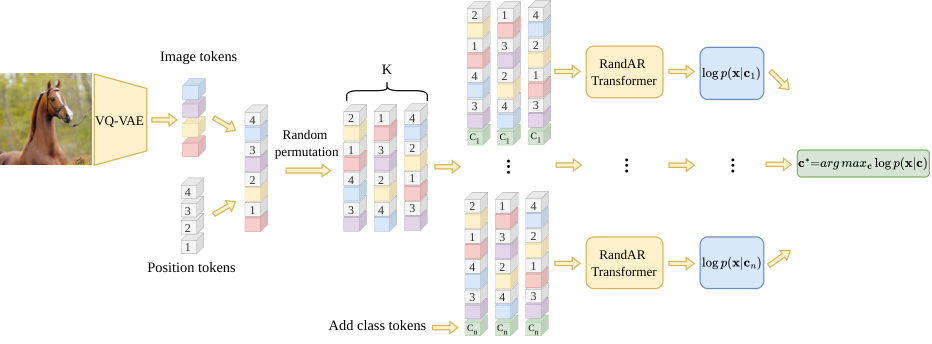
Method diagram: image tokens are evaluated in multiple orders and their class-conditional scores are combined.
Classification across token orders

Revisiting Autoregressive Models for Generative Image Classification

Ilia Sudakov, Artem Babenko, Dmitry Baranchuk

ECCV 2026

A fixed token order limits autoregressive image classifiers. Averaging log-likelihood scores across token orders improves classification, with up to 25× faster inference than the evaluated DiT classifiers.

My contribution

I hypothesized that combining log-likelihood scores across token orders would improve classification and developed order-averaged scoring with RandAR. I also identified the objective’s equivalence in expectation to a masked-diffusion evidence lower bound.
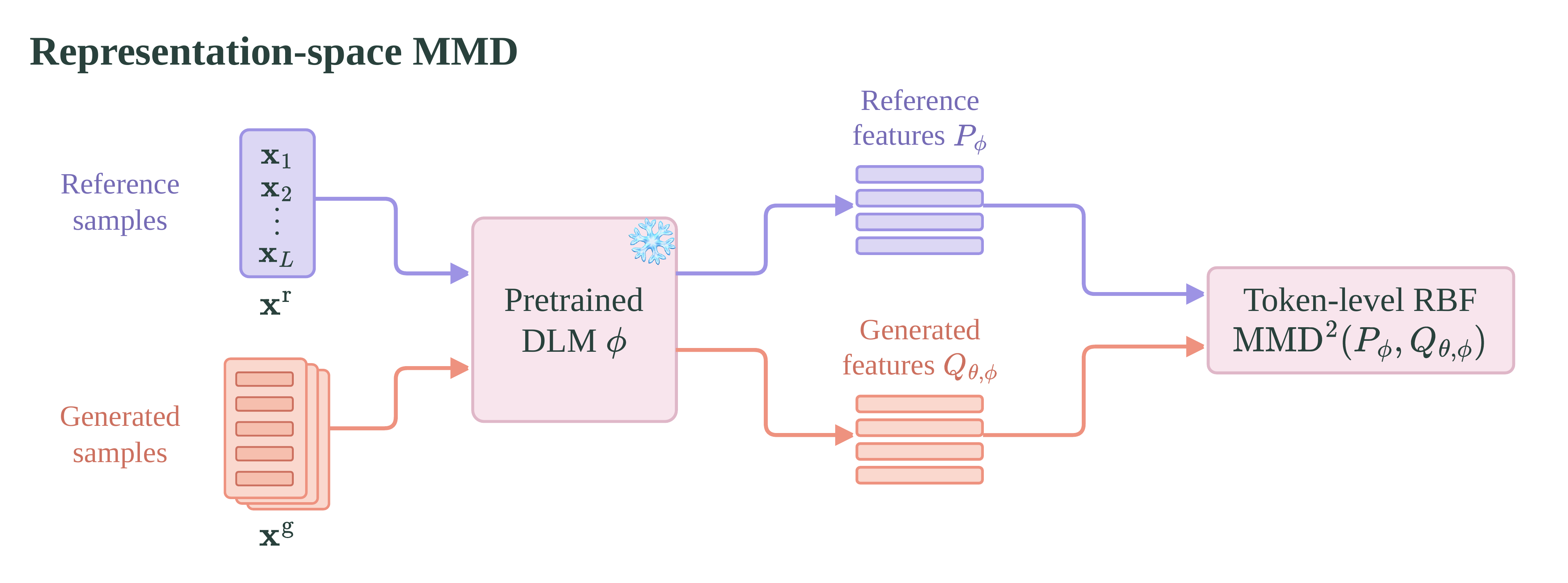

Generated and reference samples pass through a frozen diffusion language model; MMD compares their contextual features.
Matching contextual representations

Representation-Space MMD for Diffusion Language Models

Ilya Drobyshevskiy*, Ilia Sudakov*, Maksim Semenov, Denis Kuznedelev, Maksim Ignatov, Pavel Temirchev, Nikita Balagansky, Viacheslav Meshchaninov, Nikita Gushchin, Dmitry Baranchuk

Preprint · 2026Earlier version: DiffuLM 2026 oral

Matching generated and reference text in contextual representation space provides a post-training objective for diffusion language models. On GSM8K, a 16B DMax model decodes about 12% more tokens per forward pass at the same 92.1% accuracy as the published DMax-Math baseline.

My contribution

I led the discrete diffusion post-training branch, proposed REINFORCE optimization and cross-sequence comparisons to account for dependence between token features, and adapted the method to 16B DMax models.

PCA visualization of intermediate patch features without registers.Without registers PCA visualization of intermediate patch features with registers.With registers
Intermediate feature maps

Registers Matter for Pixel-Space Diffusion Transformers

Nikita Starodubcev, Ilia Sudakov*, Ilya Drobyshevskiy*, Artem Babenko, Dmitry Baranchuk

Preprint · 2026Earlier version accepted at SPIGM (ICML 2026 workshop)

Register tokens improve pixel-space diffusion transformers even when patch-token outliers are absent. Their effect on intermediate features motivates Register Guidance, which improves generation quality.

My contribution

I analyzed activations with and without registers and used linear probes to study the image information they encode. I evaluated register count, layer placement, and activation regularization to investigate their effects on image-token representations and generation quality.

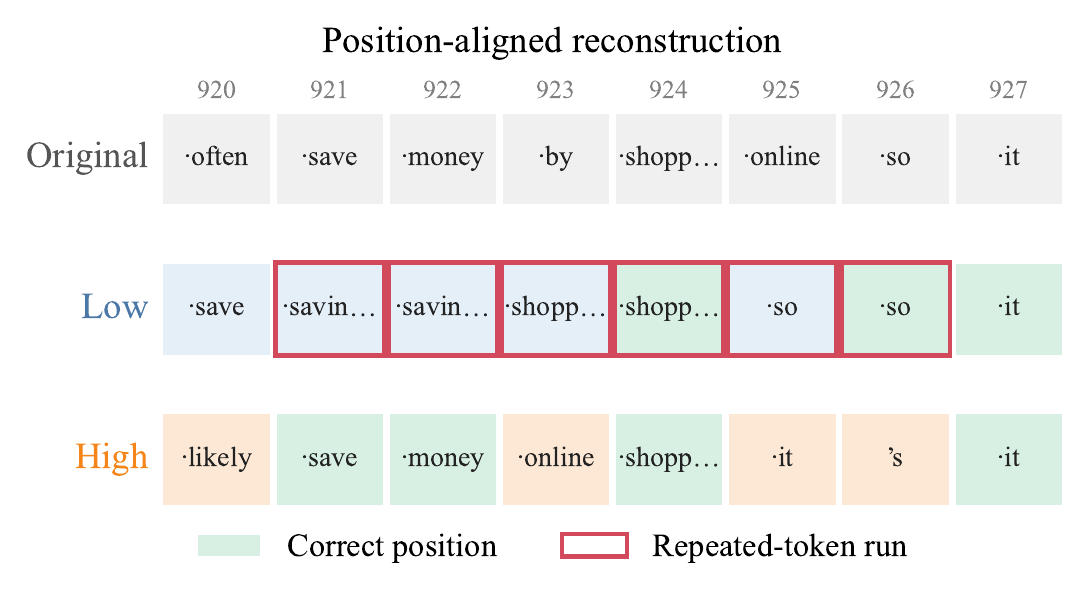
Original tokens and reconstructions from low- and high-frequency representations. Green marks correct positions; red outlines repeated-token runs in the low-frequency reconstruction.
Token positions in reconstruction

A Spectral Perspective on Continuous Diffusion Language Models

Nikita Starodubcev, Denis Kuznedelev, Ilia Sudakov, Viacheslav Meshchaninov, Dmitry Baranchuk

Manuscript under review

Frequency-domain analysis reveals approximate power-law spectra in text representations. High-frequency components carry important information about token identity and position.

My contribution

I conducted the initial Fourier analysis across token positions and identified approximate power-law spectral decay. I designed frequency-band removal and noise interventions to study token reconstruction and positional errors.

Teaching and talks

  • 2025–present
    HSE University

    Seminar instructor in Deep Learning and lecturer in the Research Seminar.

  • 2026–present
    Yandex School of Data Analysis

    Instructor in Generative Modeling in Computer Vision.

  • 2025–present
    Research Seminars on Diffusion Models

    Presented six reading-group sessions on diffusion language models, image/video generation, and representation learning.

  • October 2026
    Fall into ML 2026

    Paper presentation

Honors